
The short answer
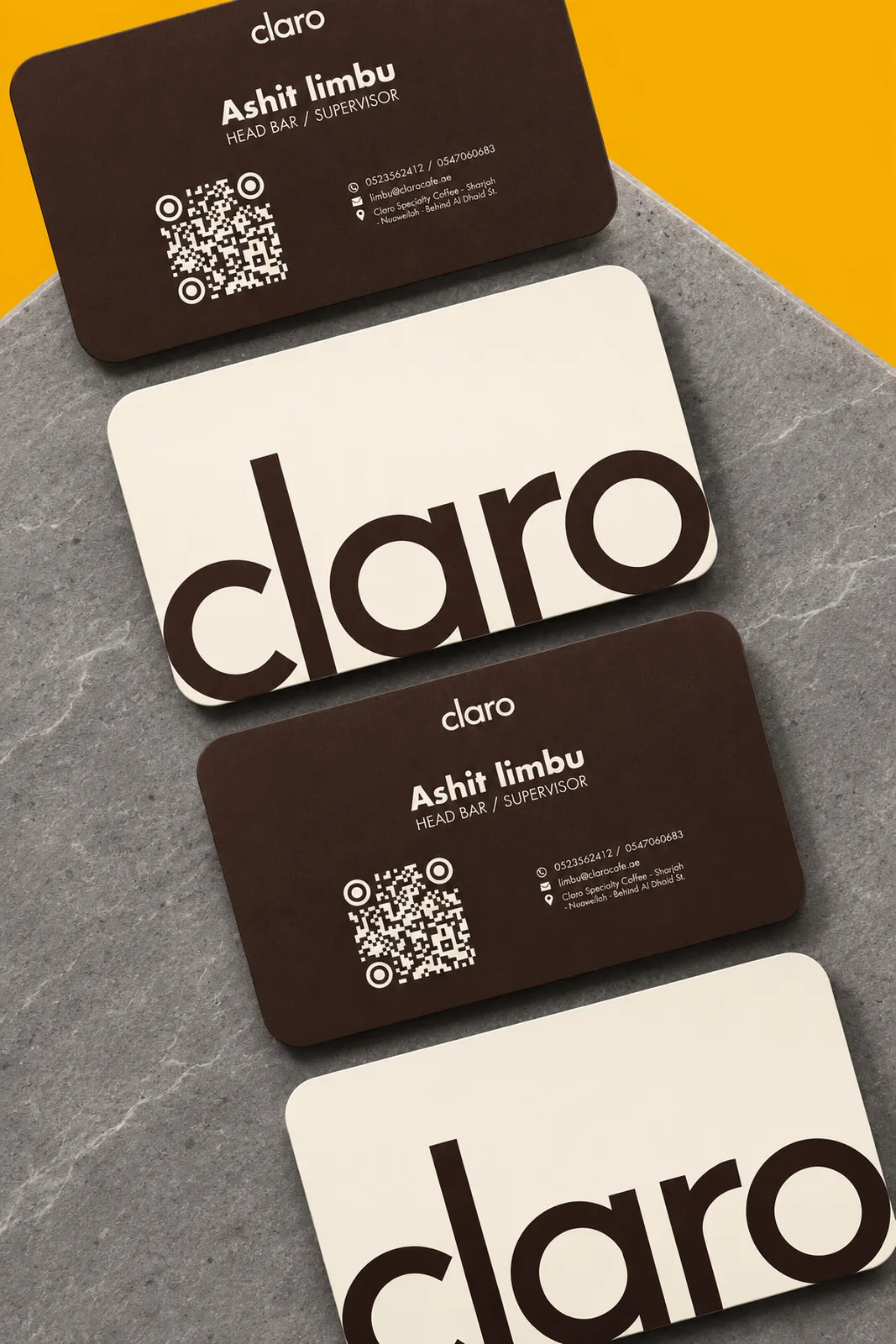
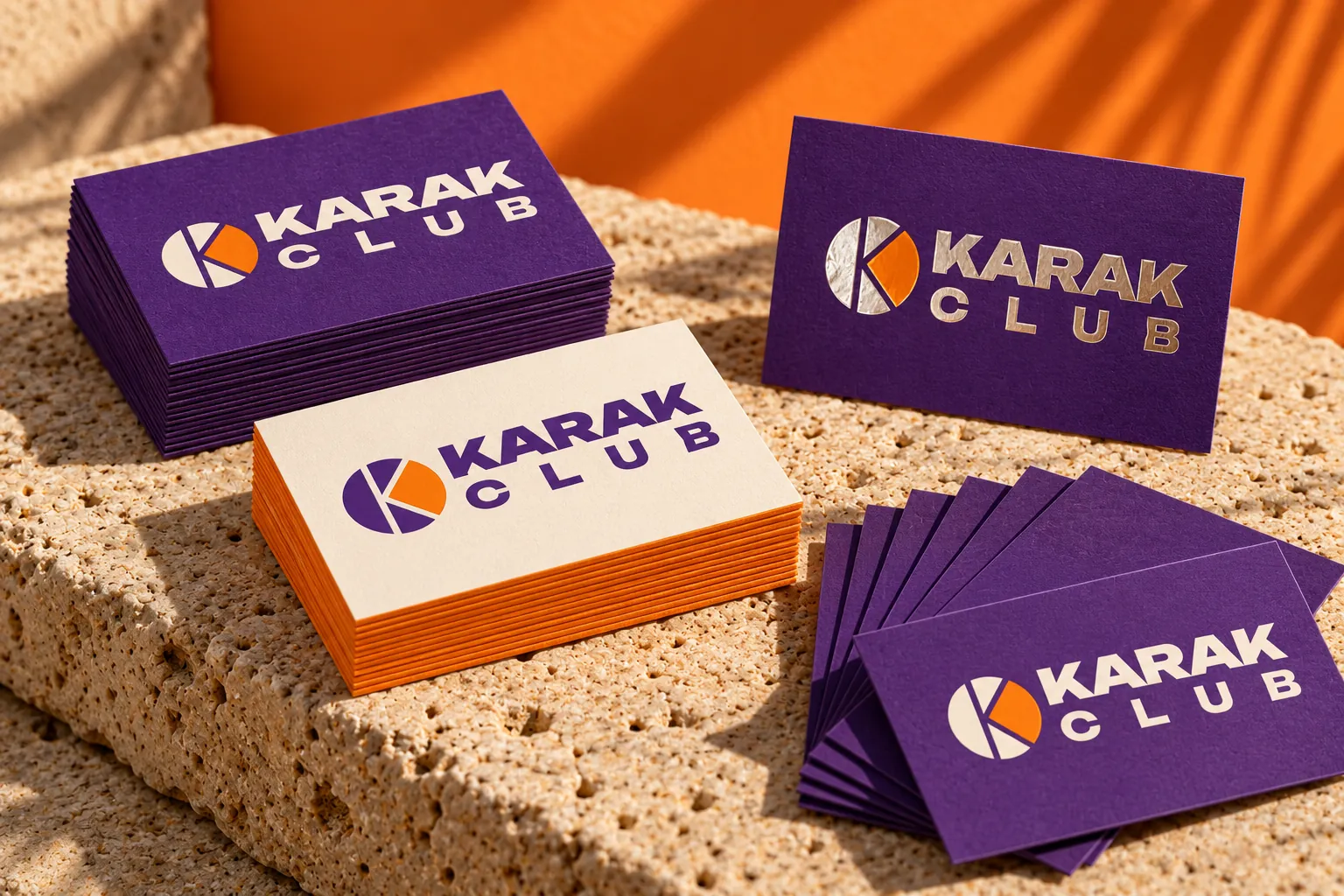
The most common business card size in the UAE is 90 x 50 mm, with 85 x 55 mm also widely used. Standard cards are printed on 350 to 400 gsm board; premium cards use 600 gsm and above, often with soft-touch lamination, foil or spot UV. Quantity, stock and finishes drive the price far more than design.
Business card printing is one of the most searched print services in Dubai, and the market ranges from same-day digital shops to presses producing thousands of cards for corporate teams. This guide covers the decisions that change how a card looks, feels and costs, from a team that prints them on offset presses every week.
Business card sizes
Final trimmed sizes. Add 3 mm bleed on every edge when you set up artwork.
| Format | Size (mm) | Size (inches) | Notes |
|---|---|---|---|
| UAE / Gulf standard | 90 x 50 | 3.54 x 1.97 | The most common size in the UAE; fits most card holders |
| European / ISO standard | 85 x 55 | 3.35 x 2.17 | Common with European companies and some UAE designers |
| US standard | 88.9 x 50.8 | 3.5 x 2 | Used by US-headquartered firms |
| Square | 55 x 55 or 65 x 65 | 2.17 x 2.17 or 2.56 x 2.56 | Distinctive; check it fits your cardholder |
| Slim | 85 x 40 | 3.35 x 1.57 | Minimal designs; less room for bilingual text |
| Folded | 90 x 100 flat, folds to 90 x 50 | 3.54 x 3.94 flat | Room for a map, services list or both languages on separate panels |
Card stocks by weight and feel
Typical options. Heavier is not always better; the right stock suits your design and finish.
| Stock | Typical weight | Feel | Best for |
|---|---|---|---|
| Coated art card (matt or gloss) | 350 to 400 gsm | Smooth, standard thickness | Everyday cards, full-color designs, large staff orders |
| Uncoated or textured board | 300 to 400 gsm | Natural, writable | Creative and hospitality brands; easy to write on |
| Kraft board | 300 to 400 gsm | Brown, natural fiber look | Cafés, eco-positioned brands; best with dark or white ink |
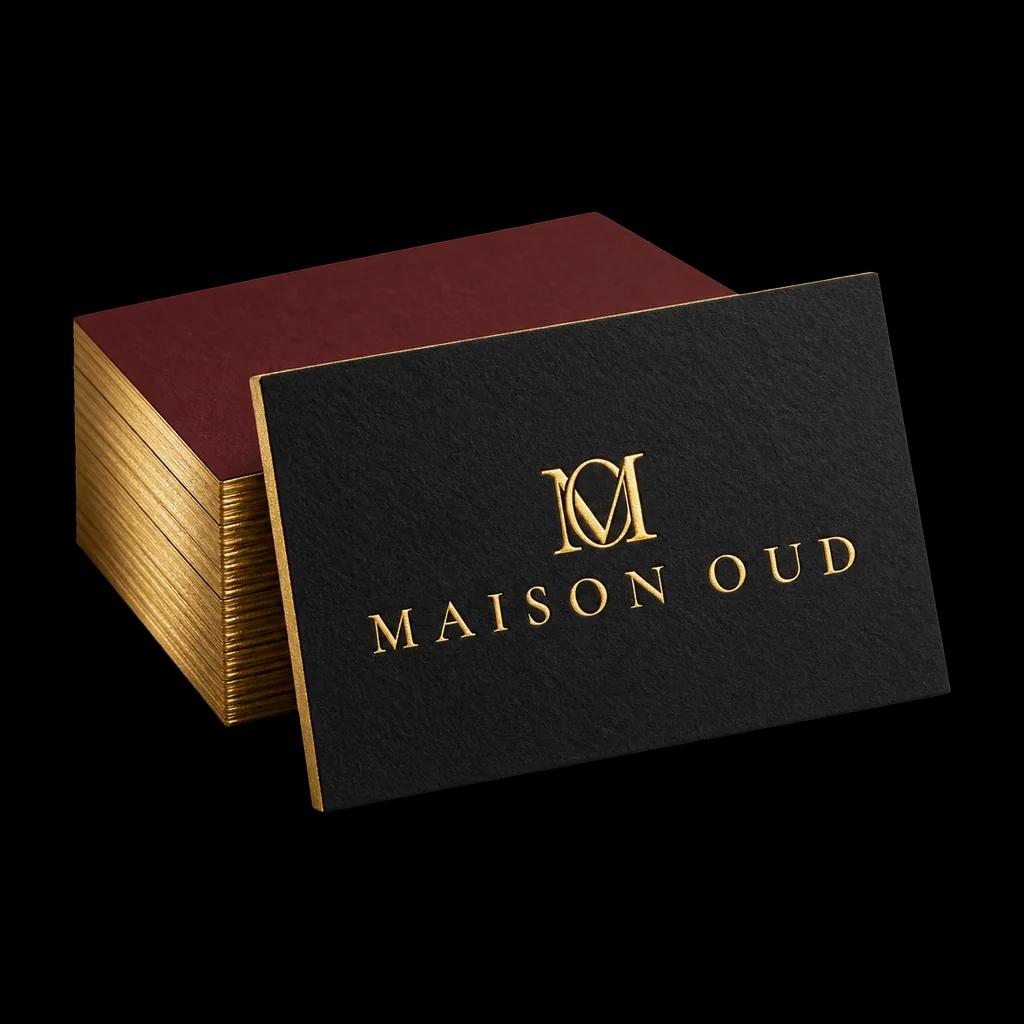
| Duplexed board (two sheets bonded) | 600 to 800 gsm | Very thick and rigid | Premium cards, colored edges, contrasting front and back |
| Colored-through board | 300 to 700 gsm | Color runs through the card, visible at the edge | Design-led brands, often with foil or blind emboss |
Finishes and what they do
Matt or gloss lamination
A thin film that protects the card from scuffs and moisture. Matt reads as understated, gloss makes colors pop.
Soft-touch lamination
A velvety surface that people notice the moment they touch the card. It pairs well with dark colors and foil.
Spot UV
A clear gloss coating applied only to selected areas, such as a logo or pattern, so it catches the light against a matt background.
Hot foil
Metallic foil in gold, silver, copper, rose gold or colors, pressed onto the card with heat. A small foil logo is the most popular premium touch in the UAE.
Embossing and debossing
Raising or pressing in part of the design for a tactile finish. Works best on heavier and uncoated stocks.
Edge painting
Coloring the edges of thick duplexed cards. Striking with a contrasting color or metallic edge.
Rounded corners and die-cut shapes
Rounded corners resist wear. Custom shapes need a cutting die and suit brands where shape is part of the identity.
Arabic and English on one card
Many UAE businesses print Arabic on one side and English on the other. It is the cleanest approach, because each side can follow its own reading direction: Arabic right to left, English left to right. Mirror the layout between sides, so the logo sits on the right of the Arabic side and the left of the English side, or keep it centered on both.
Have a native Arabic reader check names, titles and addresses on the final proof. Transliterated names are especially easy to get wrong, and a misplaced dot in Arabic changes the word. Choose an Arabic typeface designed to pair with your English font rather than relying on a default system font, and check that the PDF renders the Arabic correctly, with letters properly joined.
Artwork setup checklist
Set the document to the trimmed size plus 3 mm bleed
For a 90 x 50 mm card, the document is 96 x 56 mm with backgrounds extending to the edge.
Keep text 4 mm inside the trim
Trimming has a small tolerance, and text close to the edge looks cramped even when it survives.
Use CMYK and name spot colors
If your brand uses a Pantone color, name it in the file so the printer can print or match it.
Set foil, spot UV and emboss on separate layers
Each finish needs its own layer or file in 100% of a single spot color, exactly registered to the artwork.
Outline or embed fonts
Check Arabic text survives export, with no broken joins or substituted fonts.
Avoid very fine detail in finishes
Foil and spot UV lines thinner than about 0.25 mm may not reproduce cleanly.
What drives the price
Business card prices in the UAE vary widely because the product does. Four things matter most. Quantity comes first: setup costs are spread across the run, so 500 cards cost much less per card than 100, and 2,000 less again. Stock is next: a duplexed 700 gsm card can cost several times a standard 350 gsm card. Then finishes: each finish, such as foil, spot UV or emboss, adds a step and often a block or plate. Last is the number of designs. A company ordering cards for 30 staff on the same design can gang them on one sheet, which keeps cost down compared with 30 separate orders.
Process matters too. Digital printing is economical and fast for small quantities and personalized names. Offset becomes cheaper per card at higher volumes and gives exact Pantone color. Our guide to offset versus digital printing explains the crossover in detail.
Same-day cards versus planned orders
Same-day business card printing exists in Dubai and is useful in an emergency. It usually means digital printing on standard stocks with limited finishes. If you want soft-touch, foil, emboss or thick duplexed board, plan for more time, because each finish is a separate production step and some need drying or curing time.
For corporate teams, a good approach is to print a stock of cards for each employee on offset when the design launches, then use digital for new joiners between larger reprints.
Business cards from GPP
We print standard and premium business cards on our offset presses, with soft-touch, foil, spot UV, embossing and die-cutting in-house, and deliver across the UAE from Ajman. Send us your design, quantity per name, stock preference and finishes, and we will quote and send a proof. If you are not sure which stock or finish suits your brand, ask for samples first.
Products in this guide
GPP Production Team
Print & packaging specialists, Ajman
Written by the people who run our presses and finishing lines in Ajman, and checked against current UAE rules where regulation is involved. Published 9 Oct 2026; last reviewed 10 Oct 2026.